Energy Performance Certificates

Energy performance certificateEnergy Performance Certificates can be useful for working out how energy efficient a house is and how hard it is to heat them in winter. There are several opinions as to whether they accurately reflect the true nature of a house’s energy use and warmth.
You need one before you can sell your house.

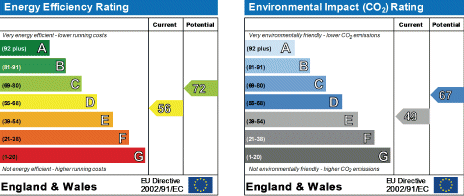
The main part of the certificate that people usually look at is the rating. This is from A-G and shows the current rating and what it could be if improvement work was done.

There are many flaws within the scheme – such as low energy lightbulbs are included in the rating – but obviously someone might take them with them when they move. However low energy bulbs are frequently on offer and even available free from energy companies.


Landlords need them for rental properties too and this can be helpful if you’re looking to move to an easy to heat property and cut your energy bills. Always make sure you ask to see the EPC. Letting agents and landlords should show it you without being prompted but if they don’t, then ask.

Some propertys can not be vastly improved. Buildings without a cavity can not have cavity wall insulation. In some areas window restrictions due to the area being a conservation zone might mean the cost of appropriate double glazed windows is too expensive.

Easy things like loft insulation and draft proofing can often make a difference though. The list of recommendations can be interesting. Some EPC are often based on guesswork which can be frustrating if they have assumed no cavity wall insulation but there actually is.


You should also have within this an estimate of bills and energy use.

There’s a summary of the home’s energy performance related features such as:

walls – whether they are cavity filled.

What type of roof it is and what insulation is had.

What type of floor is it.

What the windows are

What the main heating and it’s controls are.

Whether there is secondary heating.

What the hot water system is.

What the lighting is.

It should also state if there are any low or zero carbon energy sources. That’s things like solar hotwater or photovoltaic cells, or ground heat pumps, or wood burning stoves.

An energy performance certificate is worth looking at and checking the information on it yourself or asking a surveyor to check certain aspects.

London property tool

commute fromCommute from is a really odd looking site that helps you wrk out how long your commute across London will be. Probably quite useful but I’ve not tested it against real times to tell for sure!
It’s main feature is that it shows you which stations are within your preferred commute time of the central London tube station you use for work!

The Rightmove App

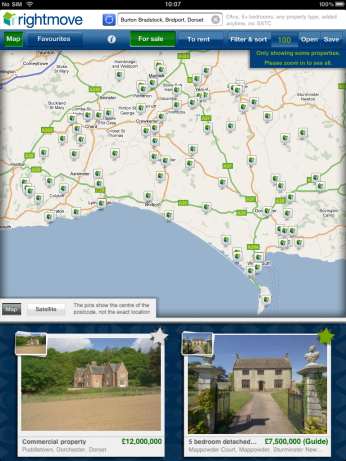
Rightmove App on iPadThe Rightmove App on the iPad is an easy way of browsing Rightmove’s houses for sale.
Whilst you can view individual houses on the iPad from a link you can’t use the actual Rightmove website in Safari to locate houses – you have to get the app. The app is free though and is easy to use.
You can type in a postcode, town or county name just as you can on rightmove. The search filters are available to help you define price, range, number of bedrooms and whether you want to see the SSTC properties too.
You view the properties on a map which can be zoomed in or out so you can further define your area. You see the houses shown a few at a time and can scroll through this list to see them all. By zooming in you narrow your area of search and this reduces the numbers of properties shown making it easier to work out which ones you are interested in.

Clicking on a property takes you to the property detail page that has the extra photos and information as well as contact details for the agent. Some pages are better than others and links to other material don’t always work on the iPad. You can add properties to favourites though or email lnks to them to yourself or friends to share the ones you like.
Using Rightmove on the iPad is easy and you’ll find yourself browsing houses on it all the time!
Rightmove’s filters are easy to apply on this and it remembers locations you’ve browsed already in a drop down list so you can revist them easily.
Overall it’s a fun and easy app to use and will help you browse for houses!

Globrix

Alternative website for browsing houses for sale or rent. Different style layout than rightmove.
Visit Globrix to see how it works for you.
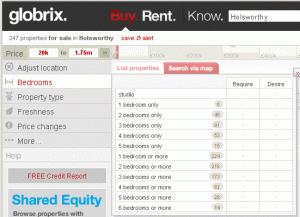
There are drag bars once you’ve put in your search area that control the prices of the properties shown. To start off they’re at the ends of the scale for the given area.
number of bedrooms
You can adjust the number of bedrooms you’re looking for by clicking on the bedrooms option. This is a clever bit of stuff that shows you how many have each number of bedrooms! Helps you decide whether you need to widen your search area.
They also show freshness – how long it’s been on the market. Not as indepth as using other property tools available (such as property bee or property snake) but handy all the same.
The features bit is possible the best bit though as it lets you pick things like swimming pool and bowling alleys, as well as solar panels. Whilst these things might not be on most people’s searches just having the option to use this sort of detailed search makes it head and shoulders above other property search sites. It’s useful if you want an annex, a 3 storey property or some other quirk!

You can also adjust Tenure, Outside space, Condition, Features, Parking, Period, Bathrooms, Estate agents, Nearby stations, Nearby schools, Distance to stations, Distance to schools, Purchase status. It’s quite an interesting array of things you can look out for.

What should be the first photo on your rightmove ad?

first photo on rightmoveWhat do you expect to see as the first photo on your rightmove ad?

I think it should be the outside of your house. If it’s not, then I’m always suspicious why.
When you see the kitchen first do you think automatically ‘What’s wrong with the outside?’.
This is especially true if it’s not a really amazing kitchen. If the front of the property isn’t a stunner packed with kerb appeal, then what can be done about that? Sometimes nothing – especially when it’s a flat or shared access. However it rings warning bells straight away and of course you’ll see the outside when you either click the streetview option on rightmove, or visit the place, or just have a drive past to see what it’s like.
I suppose if you can get someone interested – if they pass the 11 second rule just on the inside, then they might like it enough to ignore how ugly it is on the outside.
You should also remember perhaps that as long as the house opposite is pretty, it doesn’t matter what yours looks like as you will be inside and unable to see it!

Robbie Williams House still for sale

Compton Bassett, WiltshireThis article from the times last Ferbruary says that Robbie’s house Compton Bassett House is up for sale.
Compton Bassett house is a 18th century mansion that now has a swimming pool, gym, tennis court! It’s a really lovely alsmot french style house that’s been beautifully done.
View it on rightmove now.
It’s even got a helicopter hanger! It’s got 7 bedrooms over three floors and it is very stylishly done out. The main lounge room with it’s pool table looks a great room for hanging about in!
The pool area is fantastic with male and female changing rooms plus sauna and steam.
It is right next to the church though which is perhaps not something everyone would want in terms of privacy.
If you want to be nosey on google maps then click here – you can see the house just below the large square of formal garden.
This house has everything on my wish list! (Pool, gym, tennis court … nothing to do with it being Mr RW’s house!)

A good look round

Looking at a house in detail

What do you need to look out for?
You should use all your senses. Listen to creaky floors that indicate a wooden floor in need or some attention. Use your nose to see if there’s damp or rot, or just dirty dog smell ingrained into the place. Use your eyes to look at everything.

Some people buy a house after just looking at it once. You should try and view at least twice – or at least make sure the viewing you do is in depth.

You can ask to look at any sheds or outbuildings. It’s always interesting to see that doors unlock and lock back up without major hassle.

You can ask to look at the boiler and make a note of the name of it. Ask if it’s got a service history you can see too. Sometimes there’ll be a sticker near the boiler to indicate when it was last serviced.
If there are individual room heaters then look at them too. Make a note of the name of them.

Have a look at the windows, window sill and above the window. Is the window double glazed? Is it intact or has it started misting up. Whilst you can replace panes there is a cost attached to that.

Look at the heating in each room. Is there central heating or is it individual heaters. Are they thermostatically controlled? Are they warm? (In winter it’s likely the heating would be on and so it’s easier to check.)

What condition is the ceiling in? Is it papered, painted or does it have ceiling tiles?

How old is the bathroom? Does it all work? Does it look like it’s used regularly? Look at any ensuites too. Look at the sealant around the shower and bath. Are the tiles nicely grouted?

Go outside and look at the roof from the rear and the front. You can look at the front elevation before or after your viewing but you might only be able to see the back when you have access to the back garden. Ask about any side gates or access.

What are the light fittings like? Do they all match? Are there lots of sockets? What is the fuse board like? What sort of electricity meter does it have?

If you have a particular item of furniture that you want to get in then you could ask to double check the measurements of a room so it can fit in. Remember to take a tape measure and have the measurements noted down with you.

Some people also take a small pair of stepladders so they can peer in to the loft space too – take a torch as well! Ask first of course!

Take note when looking at the smaller rooms too – is there only one way round a bed can fit in?

Ask how much the heating costs to run too. Bear in mind their energy use may be different to the way you use your heating. Ask if they have got the loft insulated, cavity wall insulation and look for draft proofing around the exterior doors.

In the kitchen have a look at how many units there are. Is there enough room for the fridge you have or want? What cooker fittings does it have? Does it have a gas connection? What lighting is in the kitchen? Often there is different lighting in the kitchen whether it’s spot lights or a long fluorescent tube.
You can ask where the stop tap is. Now is a good time to ask if they’re on a water meter.

What council tax band is it?

council tax band changeIt might well say in the estate agent details what council tax band the property is in, but how do you check to confirm it?
There’s a site that has the Council Tax Valuation List which shows you. You need to identify the billing authority – which you can do by picking from a drop down list or putting in the postcode of the property.
It’ll show the current band and if the band is going to go up! Look for the Band review pending indicator
When a property is improved (e.g. an extension is built), legislation prevents the VOA from increasing the existing band of that property until there is a “relevant transaction”. The relevant transaction can be buying the leasehold or selling the property.
It’s always worth double checking the council tax band of a property before you buy it – just so you can accurately budget your new house!

Does it need rewiring?

Does a house need rewiring?


Experts reckon that a house needs rewiring after about 30 years. Older style fuse boxes are a nuisance compared to modern RCD switch styles.


When you inspect a house look out for the numbers of sockets – they may be hard to spot, so don’t be afraid to ask the owner. This is something you could ask about on a second visit. Modern needs mean more sockets are needed than every before.


A standard rewire normally puts 2 double sockets in every room, with more in the kitchen. Of course if you’re having a property rewired you can ask for the sockets to be where you want them and to have extra ones added in. A standard rewire in the North West of England costs from £1500 excluding the cost of any plastering and redecorating that will need doing.


If you spot different types of light switch within the same house then the chances are wiring has been added to at some point. You could get an electrical safety check done if it concerns you.


A look at the fuse board can be revealing. If it’s an old type then you can pay to have just this replaced, but if you know you want more sockets then a full rewire might be an option.

As with all work get several quotes and make sure you’re comparing like for like with them.

There are firms that will rewire in a day, or you can employ a company that will do it in a few days. It depends on how much time you have as to which you pick. Getting it done quickly gets it all over with quickly though and means you shouldn’t be without electric overnight at any point!

how much does it cost to rewire a house? In 2009 quotes for a standard rewire of a 3 bedroom house with 2 lots of double sockets in each room, plus extra in the lounge and kitchen, cost £1500 excluding any plastering work. This was the same quote from several different types of companies.
Always get quotes from qualified electricians. Ask them any questions you have about wired smoke alarm systems, as these seem to be standard these days.